Consultation update
Thank you to everyone who has taken the time to review and respond to the first draft of the ResponsibleGlass International Standard for Glassmaking. The feedback received so far will help strengthen the proposals as we work towards the next draft.
The 60-day consultation period closes on 18th September, and we would really appreciate it if you could submit your feedback by then. We particularly encourage all ResponsibleGlass members and supporters to take this opportunity to consider the draft from your organisation’s perspective. What works? What’s missing? Where could the requirements be strengthened or clarified?
Every response will be considered as we continue developing the Standard. Please send your comments to standards@responsibleglass.org by 18 September or use the form here.
Something for your diary: on Wednesday 7 October, we will be holding a briefing for Members and Supporters to share key themes emerging from the consultation feedback and outline the next steps in the Standard development process.
Thank you again for your continued input and support in helping to shape a robust, practical and globally relevant Standard for responsible glassmaking.
Why We Joined: Glass needs its own seat at the table, Bovis
Bovis is a main contractor delivering high rise commercial office buildings, residential developments, hospitals, cultural and university buildings and defence works.
With 99% of its emissions sitting in scope 3, most of that tied to purchased goods and services across its four big materials, concrete, steel, aluminium and glass, Bovis has long engaged with industry groups like Concrete Zero to help decarbonise its supply chain. Ceire Kenny heads up the Sustainable Futures team at Bovis and discusses here why Glass needs its own seat at the table.
Silica Sand project update incoming
Sustainability concerns associated with the extraction of silica sand are increasingly being raised in the media. We commissioned research to better understand the extent to which these concerns affect silica sand supplies for glassmaking globally, and to identify the key risks and opportunities across the supply chain.
The first phase of the Responsible Sourcing of Silica Sand for Glassmaking project, led by the Coalition for Responsible Sand and Silicates (CRSS), is exploring supply chains, material specifications, traceability and key environmental, social and governance risks.
The research will help build a clearer evidence base for understanding responsible sourcing challenges and opportunities associated with this critical input material, and will inform the future development of the ResponsibleGlass Standard.
We will share an update on the research and the findings to date at an exclusive Member & Supporter Briefing on 16 September at 15:00 BST.
Joint webinar: ResponsibleGlass x Glass Futures
ResponsibleGlass and Glass Futures are bringing their members and supporters together for a joint webinar exploring the challenges and opportunities facing the global glass industry.
The session will bring together perspectives from across the glass value chain, connecting ResponsibleGlass’s work on the sustainability Standard with Glass Futures’ focus on innovation, technology and real-world solutions for decarbonisation and circularity. Glass Futures’ Global Centre of Excellence provides pilot-scale facilities for testing and developing new approaches to glass manufacturing.
The webinar will provide an opportunity for members and supporters of both organisations to hear the latest thinking and explore how collaboration can help accelerate positive change across the sector.
We look forward to bringing our two communities together on 27 October at 15:00.
In the News: Why the construction industry needs a global Standard for responsible glass
ResponsibleGlass Chair Francis Sullivan has published a new opinion piece exploring why the construction industry needs glass to have the same level of transparency and accountability that already exists for materials such as steel, aluminium and timber.
Writing for PBC Today, Francis argues that while glass is essential to creating low-carbon, energy-efficient buildings, the industry has lacked a common, independently governed framework to define and verify responsible production. Without a global standard, it remains difficult for architects, developers, contractors and building owners to compare sustainability performance or make informed procurement decisions.
The article highlights how the ResponsibleGlass Standard will help address this challenge by creating a consistent international framework covering responsible sourcing, environmental performance, circularity, governance and social responsibility across the entire glass value chain. It also explains why collaboration between manufacturers, suppliers, customers and civil society is essential to building trust and accelerating progress.
As consultation on the draft ResponsibleGlass Standard continues, the article reinforces why now is the time for the construction industry to help shape the future of responsible glassmaking.
New Insight: Glass and the circular economy
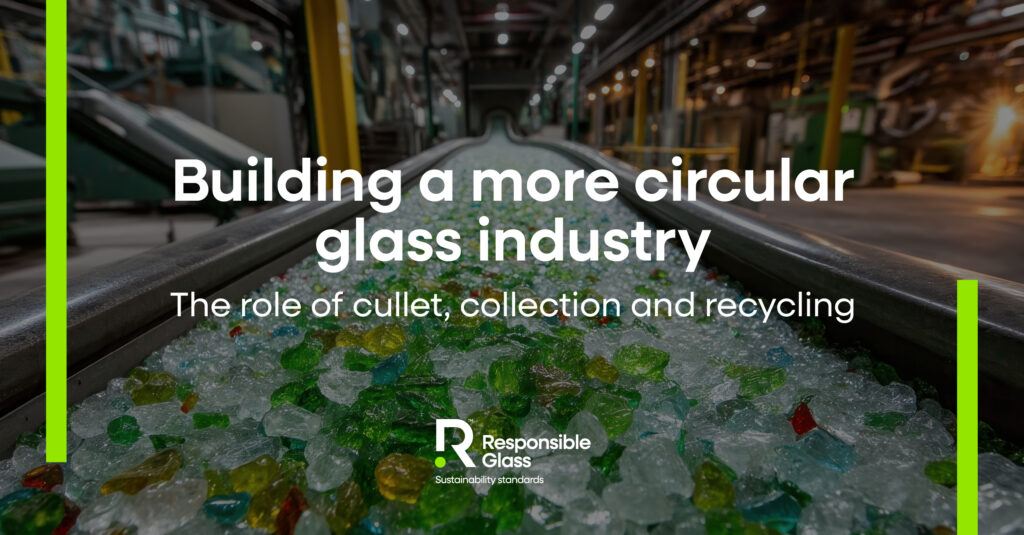
Glass has the potential to play an important role in a more circular economy, but closing the loop depends on more than the material itself. A reliable supply of clean, high-quality recycled glass, or cullet, is essential.
Our latest article looks at the role of cullet in reducing energy use and emissions, the differences between recycling container and flat glass, and why stronger collection and sorting systems are needed across different regions.
It also highlights the importance of learning from the recycling and sorting companies working directly with these materials every day.
Dates for your diary

Join ResponsibleGlass
Be part of shaping a credible, transparent future standard for the glass sector.