Consultation closes with strong engagement across the glass value chain
The consultation on the first draft of the ResponsibleGlass International Standard for Glassmaking closed on October 2nd, marking an important milestone in the development of the Standard.
Since the consultation opened, the draft Standard has been downloaded more than a hundred times, with interest and feedback coming from across the glass value chain, including glassmakers, raw material suppliers, glass buyers and civil society.
We have also received valuable and constructive insights throughout the consultation. The responses are helping to test the draft Standard against the practical reality of the sector, highlighting areas where further clarity is needed and identifying opportunities to strengthen the framework.
The breadth of participation provided a valuable, holistic view of how the Standard is being understood from different perspectives, including glassmakers, upstream suppliers, downstream users, technical experts and civil-society organisations.
Feedback was broadly positive about the ambition, scope and potential value of the Standard, and we are particularly grateful to those respondents who provided detailed comments across the consultation questions and individual sections of the draft. The responses offered constructive recommendations to support further development, including ensuring requirements are practical and proportionate across different glass subsectors and facility types, strengthening interoperability with existing standards, certification and assurance schemes, and providing greater commentary on sections around traceability, data and verification requirements, responsible sourcing and due diligence, greenhouse-gas reduction pathways, circularity, and downstream claims and chain of custody.
Together, this feedback provides a strong evidence base for refining the next draft and will help ensure that the Standard remains both ambitious and grounded in the realities of the global glass value chain.
The work continues
On October 7th, ResponsibleGlass will hold a dedicated Members and Supporters Briefing to share an initial overview of the consultation and discuss what happens next.
This will be followed by further engagement with stakeholders on specific areas of the draft Standard. The insights gathered through this process will inform the next stage of drafting, with Version 2 of the ResponsibleGlass International Standard for Glassmaking planned for the new year.
Thank you to everyone who took the time to read, consider and contribute to the draft. Your input is helping to shape the development of a Standard for the sector.
First look at ResponsibleGlass research into glass-grade silica sand
Silica sand is the most important raw material in glassmaking, accounting for up to 75% of material inputs by volume. Glassmaking requires high-purity silica sand with tightly controlled grain size and low levels of contaminants. Yet much of the existing research into the sustainability impacts of sand extraction considers glass-grade silica sand alongside construction sand and other aggregates without differentiation.
As ResponsibleGlass develops the responsible sourcing requirements for the Glassmaking Standard, an important question is whether the environmental, social and governance (ESG) risk profile of sand used for glassmaking is actually distinct, and if so, what are the implications.
To explore this, ResponsibleGlass commissioned the Coalition for Responsible Sand and Silicates to undertake a focused study of the glass-grade silica sand supply chain. Louise Gallagher and Elin Post presented the preliminary findings to members and supporters at a recent briefing.
A distinct material with a distinct supply chain
The research confirmed the ways in which glass-grade silica sand differs significantly from many of the other types of sand covered in wider sustainability research. The requirements vary by application, with the highest-purity sands used for applications such as solar glass. The researchers estimated that the glass sector uses around 60–100 million tonnes of virgin silica sand each year, representing roughly a third of global industrial silica sand use.
Glass-grade silica sand is primarily extracted from terrestrial deposits through open-cast quarrying and, in some cases, underground mining. Unlike some other forms of sand extraction, it is not typically sourced through river or marine dredging.
Strong foundations for traceability
One of the study’s most significant findings was the relatively high level of traceability within glass sand supply chains.
Glassmakers need consistent raw material quality, meaning there is already a strong commercial incentive to maintain visibility back to the source. The research found that supply chains can remain traceable even when material travels significant distances.
However, traceability is more challenging where companies make use of spot purchasing, traders or agents, or where different sources are blended.
The level of visibility also varies between glass applications. Solar and display glass supply chains showed particularly strong traceability, while container glass, where specifications allow a wider range of sand sources, showed less visibility.
Understanding the ESG risks
The study used the OECD Due Diligence Guidance as a framework to examine the potential ESG risks associated with glass-grade silica sand.
Among the risks identified were greenhouse gas emissions, biodiversity loss, bribery and fraudulent misrepresentation and occupational health and safety, including exposure to silica dust and the risk of silicosis.
Other potential risks require further investigation, while some risks commonly associated with sand extraction, particularly those relating to river and marine dredging, were considered less relevant to glass-grade silica sand.
The findings provide an important starting point for understanding where the sector can focus its efforts.
What happens next?
The research will now help inform the responsible sourcing section of the ResponsibleGlass Standard.
A key next question is which sustainability framework is most appropriate for silica sand extraction sites, including whether existing approaches such as IRMA are suitable for operations that can differ significantly in scale and nature from metal mining.
ResponsibleGlass will continue to engage members and stakeholders as this work develops. The full report will also be shared with members and supporters in the coming weeks.
Meet the team: Matthew Wenban-Smith, Standards Lead
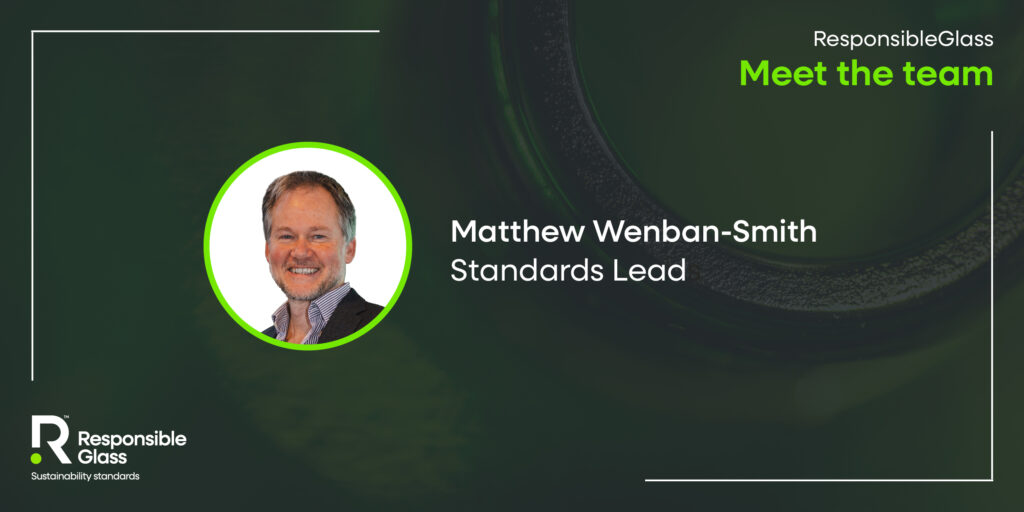
Matthew Wenban-Smith’s route into sustainability standards began in forestry, at a time when the very notion of “sustainable” forest management was contested and direct action against forest management and timber companies was not unusual. Those debates led Matthew to the Forest Stewardship Council (FSC), one of the early multi-stakeholder sustainability programmes, and then to a career as a consultant working across a remarkably diverse range of sustainability challenges, from mining and marine stewardship to steel and even eels.
Today, Matthew brings that experience to ResponsibleGlass, where he leads the development of the ResponsibleGlass International Standard for Glassmaking. His involvement began with a study commissioned by soda ash company WE Soda, exploring the potential for an international, multi-stakeholder sustainability programme for the glass sector. The work looked at the sector’s key sustainability issues, how they could be measured and communicated, and whether an international programme could create business value while driving positive impact. That initial work ultimately helped lay the foundations for ResponsibleGlass.
Matthew’s core role now is to lead the drafting of the International Standard – a task he sees as both straightforward in principle and challenging in practice.
Deciding to write a standard is easy, but writing a standard that will both create business value for a sector and drive improvements in sustainability performance over decades is hard.
For Matthew, achieving that requires collaboration, problem-solving and goodwill across the sector. While there is much more to building a successful sustainability programme, he believes a strong standard is fundamental to achieving its objectives over the long term. Asked to identify the biggest sustainability challenge facing the glass sector, his answer is succinct: climate change. And his vision of success is equally clear. In five years, he wants to see the key glassmakers implementing the ResponsibleGlass International Standard across all their sites, with the others “racing to catch up”.
Away from standards and sustainability, Matthew is also a keen reader. He is currently supposed to be reading Butter by Asako Yuzuki, but admits he has instead become absorbed in Careless People by Sarah Wynn-Williams. There is also a more sector-relevant book that has just landed on his doorstep: Future Build: How Construction Can Heal the Planet by Will Arnold. A former structural engineer at Arup and Head of Climate Action at the Institution of Structural Engineers, Arnold is someone Matthew previously crossed paths with. And, appropriately for someone helping shape the future of responsible glassmaking, the book looks at glass alongside steel, concrete, aluminium and bricks.
“I can’t wait to see what he has to say.”
Join ResponsibleGlass
Be part of shaping a credible, transparent future standard for the glass sector.